
For decades, the tech industry has chased the “holy grail” of connectivity: a way to beam high-speed internet everywhere on Earth without the multi-billion-dollar price tag of rocket launches or the physical limitations of underground fiber cables.
The answer isn’t coming from deep space or a new ground tower. It’s coming from the stratosphere.
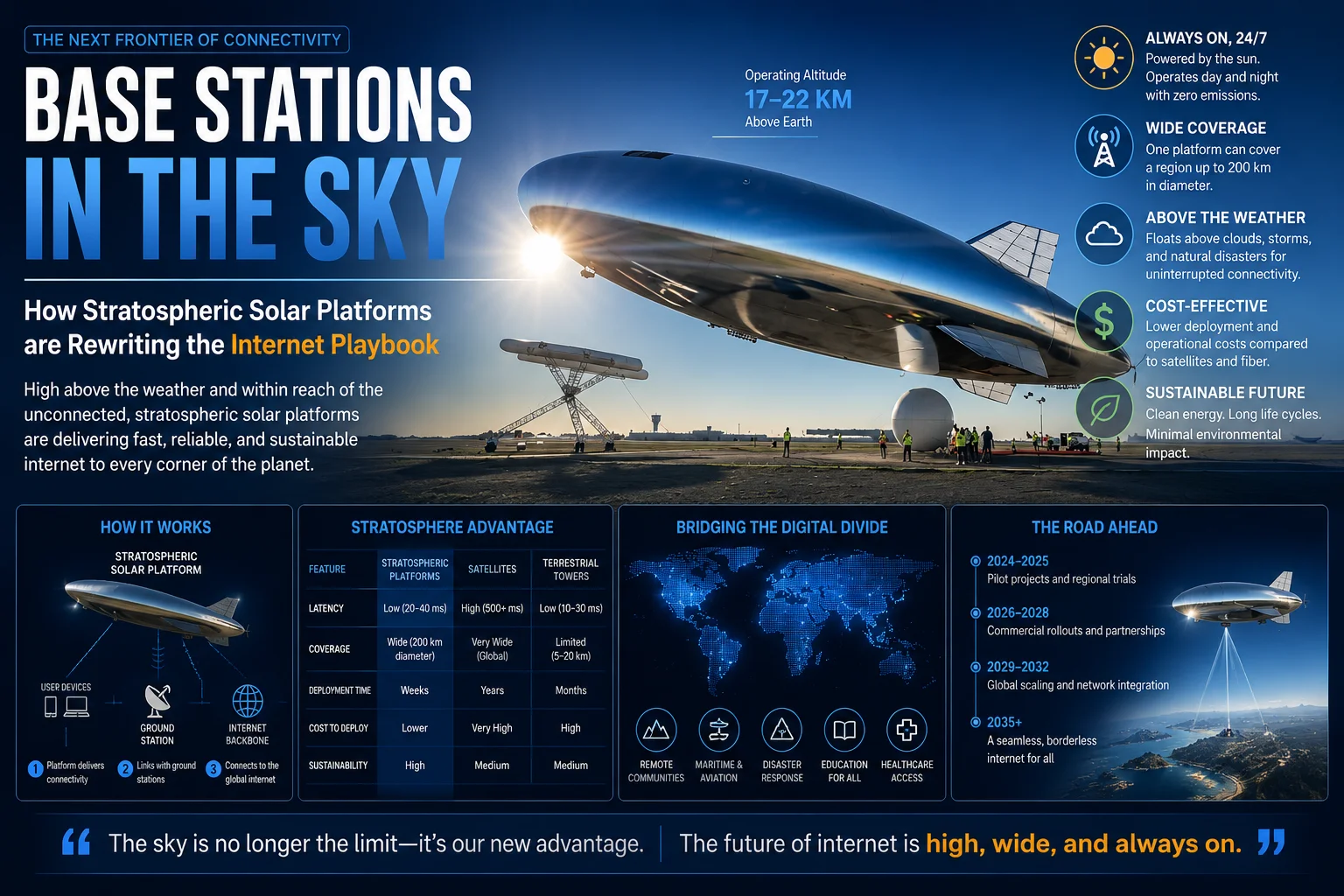
Aerospace and materials science company Sceye is preparing to launch a massive, 270-foot-long solar-powered airship to Japan. Partnering with telecom giant SoftBank, this High-Altitude Platform Station (HAPS) will act as a floating 5G cell tower, parking 18 kilometers (around 60,000 feet) above the Earth to beam data directly to standard smartphones.
Sceye’s silver, solar-powered stratospheric platform during launch prep.. Source: Sceye
The Tech: A 270-Foot Silver Bullet Powered by the Sun
The platform looks less like a traditional airplane and more like a high-tech, ultra-reflective silver bullet. Longer than a Boeing 747, the vehicle uses helium for massive lifting capacity, allowing it to carry heavy, complex telecommunication payloads that smaller, fixed-wing solar drones cannot manage.
To stay airborne for months at a time without landing, the system relies on an elegant daylight energy loop:
- Daytime: Ultra-lightweight solar panels lining the top of the hull power an electric propulsion fan to fight stratospheric winds while simultaneously charging onboard batteries.
- Nighttime: The vehicle switches seamlessly to custom lithium-sulfur batteries. These cells pack a massive energy density of 425 watt-hours per kilogram—far outperforming the 250–300 Wh/kg limits of modern electric vehicles—allowing the craft to maintain its altitude and position through the dark.
One Platform to Replace 500 Towers: Operating through a custom-built antenna system called SceyeCELL, a single airborne platform can dynamically steer network signals to cover an area equivalent to roughly 500 traditional ground towers.
How HAPS Fills the Connectivity Gap
Until now, global internet infrastructure has been a binary choice between local ground networks and orbital satellites. Stratospheric platforms carve out an entirely new infrastructure layer that balances the best of both worlds.
| Feature | Ground Towers | HAPS (Stratospheric) | LEO Satellites (e.g., Starlink) |
| Altitude | 0.03–0.1 km | 18–20 km | 500–1,200 km |
| Latency (Delay) | Imperceptible | Ultra-Low (<1 millisecond) | Low (25–40 milliseconds) |
| Coverage Area | Highly localized | Massive (Up to 140 km radius) | Continental / Global |
| Hardware Upgrades | Easy, manual access | Easy (Can fly down for maintenance) | Impossible (Burns up on re-entry) |
| Direct-to-Device 5G | Yes | Yes (No special antenna needed) | Limited / Requires specialized chips |
Why This Matters: Disaster Relief and 3D Networks
SoftBank and Sceye are deploying the pre-commercial network infrastructure with two major objectives in mind:
1. Bulletproof Disaster Response
When earthquakes, floods, or wildfires knock out traditional fiber and cell towers on the ground, emergency communication vanishes exactly when rescue teams need it most. Because these platforms hover safely above the weather and commercial flight paths, they can be deployed over a disaster zone within hours to establish a persistent, localized network wrapper for emergency crews and survivors.
2. The Shift to “3D Communication”
Existing mobile networks are built on a flat, two-dimensional framework designed to connect cars and pedestrians. As commercial logistics shift toward autonomous drone deliveries and flying taxi corridors, the world requires an infrastructure capable of managing cellular signals vertically. HAPS naturally provides this “3D coverage area,” ensuring seamless tracking and safety data miles into the sky.
With competing mega-projects from Airbus’s Aalto subsidiary and NTT Docomo also scheduling test flights, the race to claim the stratosphere is officially on. If these summer trials succeed, the next generation of hyper-fast internet won’t crawl through a cable—it will float quietly in the sky.

Najaf Sial is the Owner and Lead Writer at WormZone.in, covering the latest updates across technology, science, gadgets, cybersecurity, and global trends. With a passion for digital innovation and clear, factual reporting, Farhat brings readers insightful and trustworthy news from around the world.